
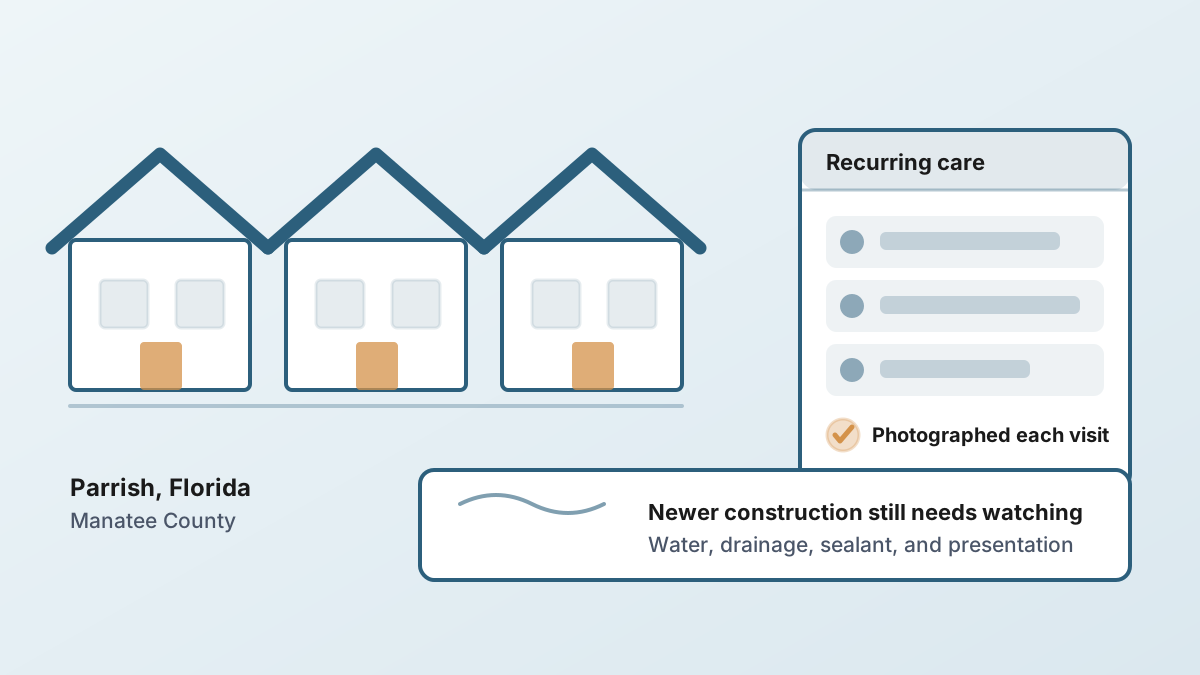
1. What Makes Parrish Rental Property Different
Parrish is one of the faster-growing parts of Manatee County, and a large share of its rental housing is recent construction in planned communities. That profile creates a maintenance pattern that differs from an older, more scattered portfolio.
- The housing stock is newer. Systems and finishes are typically well within their service life, so failures tend to be sudden rather than gradual.
- Properties cluster in planned communities. Many rentals sit inside associations with their own standards for exterior appearance and upkeep.
- Portfolios are often geographically spread. An investor may hold property in Parrish alongside property in Bradenton or further south, which multiplies travel.
- Tenants are frequently long-distance or newly arrived. Communication and documentation carry more weight than they would with a tenant you see regularly.
- Vacancy windows are tight. In an active rental market, the gap between tenancies is short, which compresses turnover work.
None of those is a problem on its own. Together they argue for treating the property as a managed, recurring commitment rather than something attended to when it raises its hand.
Managing rentals in Parrish or across Manatee County?
Suncoast provides recurring property care, minor maintenance within scope, and turnover field work for landlords and property managers.
Request Property Service2. Newer Construction Is Not Maintenance-Free
The most common misconception about newer rental property is that it needs little attention. In practice, newer construction has its own set of items worth watching, and several of them are water-related.
- Irrigation and landscaping. Newly established plantings and irrigation systems are a frequent source of overwatering and of water sitting where it should not.
- Drainage and grading. How a newly built lot actually drains becomes visible over the first few wet seasons, not on the day it is finished.
- Caulking and sealant. Exterior sealant and wet-area caulking age, and a small gap is the entry point for a much larger visible problem.
- Condensate and HVAC. A blocked condensate line produces visible damage long before it produces an obvious symptom.
- Filters and consumables. Skipped filter changes shorten equipment life quietly and are easy for a tenant to overlook.
- Builder-grade components wearing at their own pace. Fixtures, hardware, and finishes in entry-level construction have their own service life, and it is often shorter than the tenant expects.
The through-line is that visible moisture indicators and small finishing failures are what a recurring check actually catches on newer property.
3. Community Standards and Exterior Appearance
Where a rental sits inside an association, exterior appearance is not only a curb-appeal question — it is a compliance question, and compliance correspondence usually reaches the owner rather than the tenant.
- Confirm what the association's documents actually require for lawn, landscaping, and exterior condition
- Establish whose responsibility each exterior element is under your lease, and state it clearly
- Build exterior upkeep into a recurring schedule rather than waiting for a notice
- Keep visible surfaces — entry, driveway, walkways, and screening — in the condition the community expects
- Where exterior buildup is visible, cleaning it is often the lowest-effort way to stay ahead of a notice
- Keep photographs of exterior condition on a recurring cycle, so you can show the property was maintained
This guide is general information, not legal advice. Your association documents and lease govern in the first instance — confirm the specifics there rather than relying on a general rule.
4. Scheduling Around Tenant Occupancy
In an occupied rental, maintenance is a logistics and communication task as much as a repair task. Getting the process right protects the tenancy and the property at the same time.
- Provide notice in the form and timeframe your lease and applicable requirements call for
- State the purpose, the date and window, and who will be attending
- Give a service window rather than an exact arrival time — property work rarely runs to the minute
- Give the tenant a way to flag a conflict before the day rather than on it
- Keep the visit scoped to the property rather than the tenancy
- Leave the property as found, and confirm that at completion
- Record that notice was given, and when
Batching small items into a single visit reduces the number of access arrangements you need and the number of times a tenant has to rearrange a day. The same logic applies whether the property is in Parrish or anywhere else in the county.
5. Recurring Maintenance That Actually Pays Off
The value of a recurring schedule is that it catches things while they are still small and still cheap. These are the items that repay the effort most consistently:
- Visual moisture checks at ceilings, walls, under sinks, at the water heater, and at the washing machine supply
- Exterior perimeter review — walls, trim, visible sealant, gutters, and where water is draining
- HVAC condition signs — a thermostat holding setpoint, air moving at registers, a clean filter
- Vegetation clearance from the structure, roof line, and outdoor equipment
- Pest indicators — droppings, entry points, nesting material
- Visible safety items — detector presence and dated status where that is your standard
- Exterior cleaning on a cycle, rather than once the buildup is obvious
- Small repairs performed in batches, so a drip or a sticking door does not wait for something bigger
A recurring schedule also produces something with value beyond the work itself: a dated record of what the property looked like and when. That record is what makes a later conversation about condition a factual one.
6. Turnover Preparation in a Growing Market
When rental demand is strong, the gap between tenancies shortens, and turnover work gets compressed into fewer days. That is exactly when a defined process pays off.
- Document visible condition at move-out, before any make-ready work begins
- Run a punch-list walkthrough and record every item rather than working from memory
- Separate general property work from items requiring a licensed trade, and schedule the latter first
- Clear anything the previous occupant left behind, completely
- Clean after dusty work rather than before
- Handle exterior presentation — entry, walkways, and visible surfaces
- Take the move-in condition record immediately before the new tenant takes possession
The compressed timeline is the reason to decide the sequence in advance. When there are only four days, there is no time for a debate about what order things happen in.
7. Coordinating Vendors Across a Spread-Out Portfolio
An investor holding property in Parrish alongside property elsewhere in Manatee or Sarasota County faces the same fundamental cost as any spread-out portfolio: travel. Managing it is mostly a matter of grouping.
- Group by property first, then by proximity across properties that are close together
- Within a property, separate licensed trade work from general property work
- Hold small requests in one list and act on them on a cadence rather than dispatching on arrival
- Send one consolidated written scope per property rather than a stream of individual requests
- Set up a documented access method before you need it, and rotate credentials when an arrangement ends
- Confirm completion against the scope, not against the fact that someone attended
Where a task requires a licensed trade, Suncoast can help coordinate authorized property access or recommend that you contact an appropriately qualified professional. General property care, visual checks, cleanouts, exterior cleaning, and minor maintenance within scope are what we provide directly.
8. Parrish Rental Maintenance Checklist
- Treat the property as recurring care rather than reactive repair
- Confirm what the community association requires for exterior condition
- State in the lease whose responsibility each exterior element is
- Schedule visual checks on a defined recurring interval
- Check visible moisture indicators at ceilings, walls, and under sinks
- Check the water heater and washing machine supply connections
- Confirm the condensate path is clear
- Confirm filters are replaced on schedule
- Review the exterior perimeter for sealant gaps and drainage
- Keep vegetation clear of the structure and roof line
- Clean exterior surfaces on a cycle rather than reactively
- Give tenants proper notice in the required form and timeframe
- Give a service window rather than an exact arrival time
- Batch small items into a single visit
- Separate licensed trade work from general property work
- Document condition at move-out before make-ready begins
- Complete the punch-list walkthrough and re-walk it
- Clean after dusty work is finished
- Record move-in condition immediately before possession
- Confirm completion against the written scope, with photographs