
1. Which Property Tasks Can Be Outsourced?
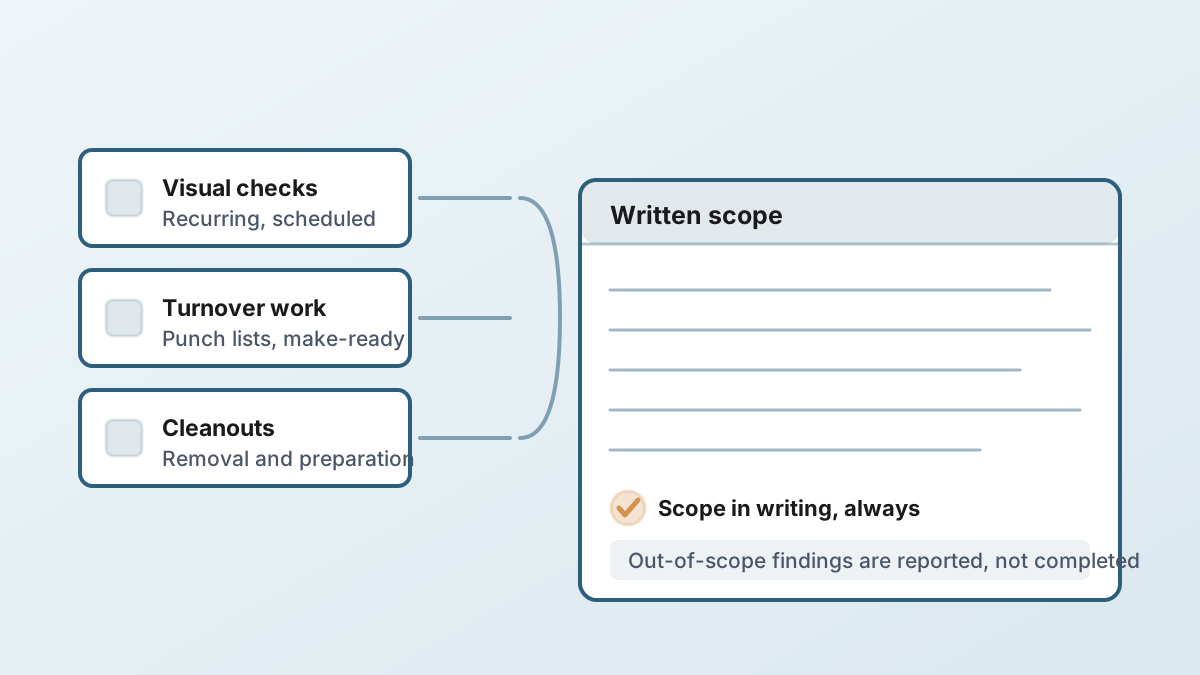
The tasks that outsource well share three traits: they are repetitive, they are geographically spread out, and they do not require a decision each time.
- Scheduled visual property checks — regular walkthroughs with notes and photographs
- Turnover field work — punch-list follow-up, cleanout coordination, and make-ready tasks within scope
- Cleanouts and item removal — removing what has been left behind during a transition
- Exterior cleaning and pressure washing — surface upkeep on a recurring cycle
- Minor maintenance — small repairs and adjustments that do not require a licensed trade
- Condition documentation — organized visible records at move-in, move-out, and milestones
- Vendor access coordination — meeting a scheduled trade at the property and confirming completion
The common thread is that each of these has a defined outcome and a repeatable process. That is exactly what makes them delegable.
Carrying a portfolio across Sarasota and Manatee County?
Suncoast provides recurring field support, turnover work, and minor maintenance for landlords and property managers.
Request Property Service2. What Should Stay In-House?
Just as important as deciding what to delegate is deciding what not to. These belong with you:
- Decisions with financial consequence — approving a repair, authorizing a scope change, setting a budget
- Anything with legal or lease implications — access notices, deposit determinations, correspondence with tenants
- Hiring licensed trades — plumbing, electrical, HVAC, roofing, and similar should be engaged under your authority or the owner's
- Owner communication — the relationship and the reporting judgment stay with you
- Anything outside a provider's stated scope — if it is not clearly in the written scope, it is not delegated, and assuming otherwise is how gaps appear
A useful framing: outsource the doing and observing, keep the deciding. Providers that stay within that boundary tend to be far easier to work with, because neither side is guessing about authority.
3. Define the Scope Before You Hand Anything Off
Most disappointing outcomes in outsourced property work trace back to an undefined scope rather than to poor execution. The work was done — it just was not what the person handing it off had in mind.
A scope that holds up generally answers these questions in writing:
- What exactly is included, and what is explicitly excluded?
- What is the expected outcome — what does "done" look like?
- What is the timeframe, and is there a fixed date or a service window?
- Who supplies materials, and who disposes of removed items?
- What access is being provided, and to whom?
- What reporting comes back, and in what format?
- What happens if the provider finds something outside the scope?
That last question is the one most often left out, and it is the one that prevents surprises. The answer should be simple: work outside the approved scope is reported and waits for authorization rather than being completed and billed.
4. How to Describe Work So It Gets Done Correctly
Description quality drives outcome quality. A few habits make a meaningful difference:
- Be specific about location. "The second bedroom closet" beats "the back bedroom."
- Distinguish observations from instructions. "There is a stain on the ceiling" is an observation. "Document the stain and report" is an instruction. Sending the first and expecting the second is a common source of confusion.
- State the standard. "Broom clean" and "move-in ready" mean different things to different people — say which you mean.
- Include photographs when the request is visual. A photo of the item removes ambiguity faster than a paragraph describing it.
- Note constraints up front — parking, gate codes, whether utilities are on, whether a tenant is present.
- Batch related items into one request rather than sending five separate messages over a week.
5. Setting Up Access and Authorization
Access is the most common practical obstacle to outsourced property work, and it is entirely solvable with setup done in advance.
- Establish a documented access method — lockbox, keyed entry, or a smart lock with a temporary code
- Record who is authorized to enter and on what basis, and keep that record current
- Confirm who holds and controls alarm codes, and how a temporary code is issued and revoked
- Provide gate and community access details for properties inside managed communities
- Confirm the property's utilities are on, so work is not blocked on arrival
- Have a defined process for a scheduled visit where access fails, rather than an unplanned lockout
Rotating credentials when a relationship ends is part of this. Access that is convenient for one provider is also access that persists after the arrangement changes.
6. What Completion Reporting Should Include
Reporting is where outsourced work either creates leverage or creates more work for you. A useful report typically includes:
- Confirmation of what was completed, against the approved scope
- Dated photographs showing the result
- Anything observed that falls outside the scope, reported rather than acted on
- Items flagged for a licensed trade, with enough detail to act on
- Confirmation of time on site and property condition on arrival and departure
- An explicit statement of anything that could not be completed, and why
The value of a consistent format is that you can skim it. Reports that arrive in a different shape every time take longer to read than the work took to schedule.
7. Pricing and How to Compare Providers
Comparing providers on a single number is unreliable because scopes differ. Two quotes for "a turnover" may describe entirely different amounts of work.
Compare on these instead:
- What is explicitly included and excluded in the scope
- Whether pricing is per visit, per service, or project-based, and what triggers a change
- How out-of-scope findings are handled and authorized
- What reporting is included as standard rather than as an extra
- Geographic coverage and whether travel affects scheduling or cost
- Whether the provider works from a written scope and written estimate as standard practice
A clear written scope with a stated estimate is worth more than a marginally lower number with an undefined boundary, because the undefined boundary is where the surprises live.
8. Common Problems With Outsourced Property Work
The recurring failure modes are predictable enough to design around:
- Scope creep without authorization. Prevented by a clear rule that out-of-scope work is reported, not completed.
- Inconsistent reporting. Prevented by agreeing the format before the first visit.
- Access failures. Prevented by establishing credentials and a fallback before scheduling.
- Assuming capability. A provider that does general property care is not a licensed trade. Assuming otherwise on a plumbing or electrical item is a genuine risk.
- No baseline documentation. Without a dated record at the start, it is very hard to establish what changed and when.
- Unclear ownership of vendor scheduling. Decide explicitly whether the provider is meeting a trade at the property or you are.
9. Related Local Guides
Field support does not look identical across the region. Property in a newer growth community tends to raise different questions than property on the coast or in an established neighborhood, and the pages below go into that.
- Lakewood Ranch and Parrish — newer housing stock, community standards, and a higher proportion of rental and investor-owned property.
- Sarasota and Bradenton — the widest spread of property age and type, from downtown rentals to established suburban homes.
- Venice, Longboat Key, and Siesta Key — coastal exposure and a seasonal occupancy pattern that leaves many properties empty for part of the year.
Suncoast Property Service Group provides recurring property care, vacant property checks, cleanouts, exterior cleaning, minor maintenance, and condition documentation within an approved service scope throughout Sarasota and Manatee Counties. We do not provide full property management, leasing, tenant placement, or rent collection, and we do not provide licensed home inspections or licensed trade work.