1. Why Move-Out Documentation Matters
Move-out documentation establishes the condition of the property at the moment a tenant departs. Clear, dated photographs and organized written notes create an objective record that serves several purposes:
- Comparing move-out condition against the move-in baseline to identify tenant-caused damage versus ordinary wear
- Supporting security-deposit decisions with an objective record of visible conditions
- Planning make-ready work — repairs, cleaning, painting, and other tasks needed before the next tenant
- Satisfying insurer or association documentation requirements
- Creating a record that is more persuasive than an owner’s or manager’s memory if a dispute arises
Good documentation reduces the chance of arguments. Gaps in documentation create them. The mistakes below are among the most common ways owners and managers undermine their own records.
Need help avoiding move-out documentation mistakes?
Suncoast provides organized, dated property condition documentation throughout Sarasota and Manatee Counties.
Request an Estimate2. Mistake 1: Not Documenting the Move-In Condition
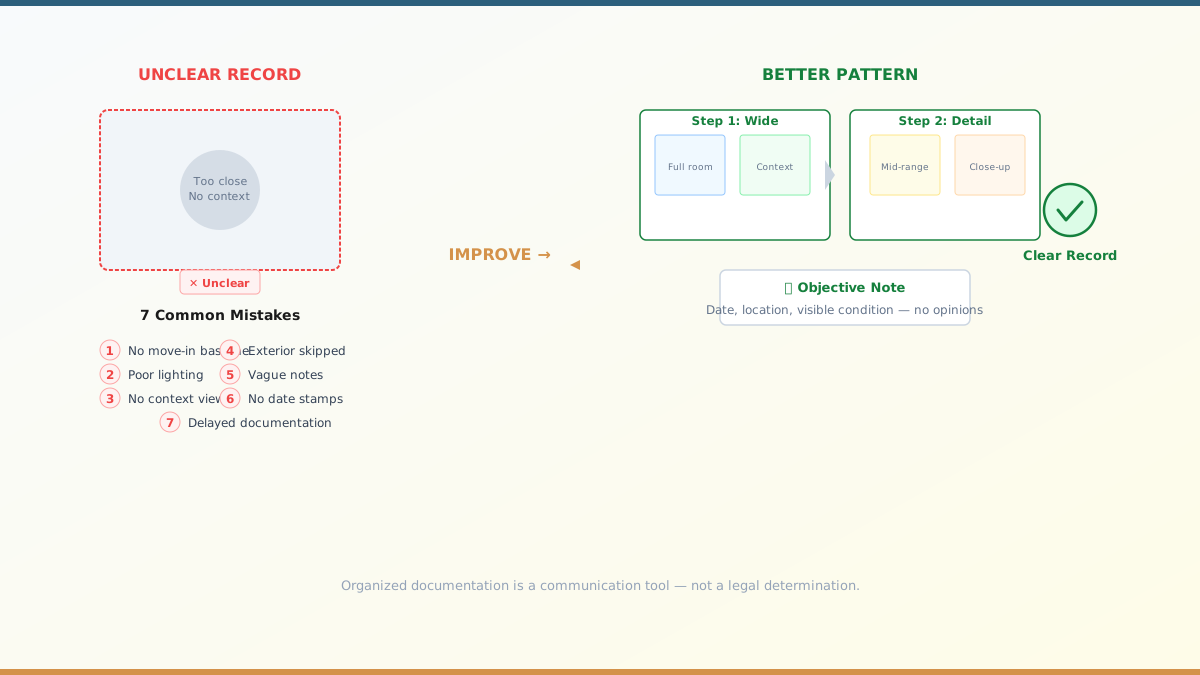
Move-out documentation has no reference point without move-in documentation. When a property was not documented at the beginning of the tenancy, every observation at move-out is just an observation — there is no baseline to distinguish pre-existing conditions from tenant-caused damage.
This is especially problematic because many tenants do not document the property themselves when they move in, and memories of what existed six months or two years ago are unreliable for both parties. Without a move-in record, deposit disputes often become a matter of one person’s word against another’s — and neither side can produce anything objective.
What to do instead: Document every property at move-in with the same level of detail expected at move-out. Dated photographs of every room, every wall and ceiling, inside cabinets and closets, appliances, flooring, and all visible plumbing connections. Store this record in an organized location that can be referenced when the tenancy ends — whether that is six months or six years later.
3. Mistake 2: Taking Undated or Low-Quality Photographs
Photographs without a legible date are easy to dismiss. Photographs that are dark, blurry, or taken from too far away to show the condition of a specific surface or item are difficult to rely on. A landlord who presents an undated photograph of a damaged wall to justify a deposit deduction has a weaker position than the landlord who can show a clear, dated, well-lit photograph taken the day the tenant moved out.
A specific issue: photographs taken in low light — particularly in hallways, closets, or windowless bathrooms — often fail to capture the condition of surfaces clearly. A wall stain that is obvious in person can look like a shadow on a smartphone photograph taken without adequate light. Opening blinds, turning on every available light, and using the camera flash when needed makes a meaningful difference in how useful the photographs are later.
What to do instead: Photographs should be clear, well-lit, and taken from a distance that shows the condition of the surface or item in question. The camera or device should produce a timestamp — ideally embedded in the file metadata — so the documentation can be tied to a specific date and time.
4. Mistake 3: Not Photographing Inside Cabinets, Closets, and Appliances
Many move-out documentation sets are spotty — the main living areas get photographed, but interior storage, appliance interiors, and utility-access areas are skipped. These are precisely the areas where damage, debris, or moisture concerns are most likely to be discovered late — after the tenant has left and the deposit has already been returned.
What to do instead: Photograph inside every cabinet, pantry, closet, and appliance interior (refrigerator, oven, dishwasher). Include photographs of the water-heater closet, the HVAC closet or access panel area, and any visible attic access. Open every door and record what can be seen.
5. Mistake 4: Not Documenting Exterior Conditions
Move-out documentation that covers only the interior leaves the exterior unaccounted for. Exterior damage — from a vehicle striking a fence, from a grill left too close to siding, from neglected landscaping that damaged irrigation — is often discovered after the fact with no record of when it occurred. Without exterior documentation at move-out, it is difficult to distinguish what existed before the tenant arrived from what happened during the tenancy.
In Florida, where summer storms and coastal conditions can affect exterior surfaces rapidly, exterior documentation also establishes whether visible staining, surface wear, or landscaping changes predate a new tenancy or occurred during it. A photograph of a clean lanai at move-out followed by a photograph of mold or mildew at the end of the next tenancy tells a clearer story than no photograph at all.
What to do instead: Photograph and document the exterior at move-out with the same attention as the interior: front elevation, rear elevation, both sides, roof (from ground level), driveway, walkways, patios, lanais, fences, gates, landscaping, and any outdoor equipment on the property.
6. Mistake 5: Not Producing an Organized Written Record That Accompanies the Photographs
Photographs alone are valuable, but a large collection of images without any written context is difficult to navigate — particularly months later when memory has faded. An owner returning to a folder of 200 unnamed photographs to decide a deposit dispute has a harder task than one who has a short written record with specific observations tied to specific photographs.
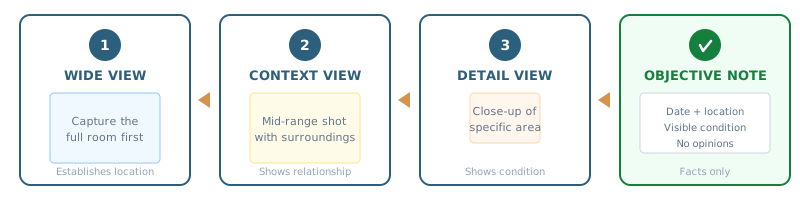
A practical approach: go room by room and note each observation. “Kitchen — sink area — no visible leaks, counter in similar condition to move-in.” “Living room — north wall — new scratch approximately 4 inches below the window, not present at move-in.” Each observation references a specific photograph, and the photograph files are named by room so they can be located quickly.
What to do instead: Pair photographs with a written record that identifies the date, the room or area, the specific item or surface observed, and what was seen. This does not require elaborate formatting — a simple list organized by room with corresponding photograph-file identifiers is more useful than photographs alone.
7. Mistake 6: Waiting to Document Until After Cleanout or Repair Work Begins
The most common sequence error: a tenant moves out, a vendor or crew arrives the next morning and begins cleaning and repairing, and only after the work is partially underway does anyone think to take photographs. By then, the original condition has been altered and any dispute over the deposit is harder to resolve.
What to do instead: Document move-out conditions before any work begins — before cleaning, before repairs, before any items are removed. The move-out documentation is the record of the condition the tenant left. The make-ready work that follows is a separate activity with its own documentation and its own purpose.
8. Mistake 7: Not Having a Consistent Documentation Format Across Properties
Owners and managers with multiple properties sometimes document each property differently — one photographed with a phone, another with a camera, one described in a text message to themselves, another in an email draft. When questions arise about a specific property months later, there is no consistent place to look and no consistent format to rely on.
What to do instead: Establish one documentation format and one storage location for every property. The specific format matters less than consistency — the goal is to make every property’s documentation findable in the same way, organized by the same structure, so it can be located and reviewed without guesswork.
9. How Suncoast Approaches Move-Out Documentation
Suncoast’s Property Condition Documentation service is built to avoid these mistakes. Every documentation visit produces:
- Dated, organized photographs of every room, every wall and ceiling surface, inside cabinets and closets, all visible plumbing connections, all floor areas, and appliance interiors
- Dated exterior photographs — all elevations, roof (from ground level), driveways, walkways, patios, lanais, fences, gates, and landscaping
- A written record organized by room with observations tied to specific photographs
- Consistent formatting across every visit — whether move-in, move-out, or periodic — stored in an organized, accessible location
Documentation is performed before any cleanout or repair work begins at the same visit, so the move-out record is never altered by make-ready activity.
Suncoast does not make security-deposit determinations, provide legal advice, or interpret Florida landlord-tenant law. Deposit decisions are the owner’s or manager’s responsibility, informed by objective documentation, lease terms, and the advice of a qualified legal professional.