
The short answer, and why it depends
If you want a starting point rather than a rule: a check every one to two weeks is a common baseline for a vacant Florida home, tightened to weekly during the rainy season, storm season, or an extended absence, and relaxed for a property that is well sealed, monitored remotely, and in a low-exposure setting.
The reason there is no universal number is that the question is really about exposure. How long could a problem develop before anyone sees it? A house with a lot of exposure — an older roof, a history of water intrusion, a pool, a wooded lot, an unfiltered irrigation system — has a shorter useful interval than a newer home with good drainage and no history of issues. Both can be "vacant," but they are not equally likely to produce a visible problem in a two-week window.
It also depends on what you want the check to accomplish. If the goal is simply reassurance that the property is standing, the interval can be longer. If the goal is a documented record that could matter later — to an insurer, a co-owner, an estate, or a contractor — the interval and the completeness of the record start to matter together.
What actually changes the right interval
These are the variables that move the answer most, based on the kinds of vacant properties Suncoast sees across Sarasota and Manatee County.
How long the property will be empty
A three-week gap between visits is a very different proposition for a two-month absence than for a nine-month one. The longer the total window, the more it matters that the interval is short enough to catch something early — and the more checks you will accumulate, which is worth thinking about up front.
The season you are in
Southwest Florida's rainy season concentrates a large share of the year's moisture into a few months. That is the period when water-related observations are most likely to be meaningful, and the period when a longer gap between visits carries the most risk of a visible issue going unobserved for a while.
The age and condition of the home
Roof age, window and door seals, the condition of the water heater, and whether the home has a history of intrusion all shift the calculus. A property with known vulnerabilities benefits from a shorter interval more than a property with none.
Whether the home has a pool
A pool that is not being serviced during an absence is its own category of risk. Water level, pump operation, and screen enclosure condition are all things that change over time and are visible during a check.
Landscaping and irrigation
An irrigation failure during a long absence can mean more than a brown lawn. Overwatering against the house, a broken head, or a system left running can contribute to conditions around the foundation that an owner would want to know about sooner rather than later.
What remote monitoring already covers
If the home has leak sensors, a smart thermostat with humidity reporting, or cameras, some information arrives without a visit. Monitoring complements a property check but does not replace it — a sensor tells you something changed, not what the property looks like.
Weekly, biweekly, or custom: what each one buys you
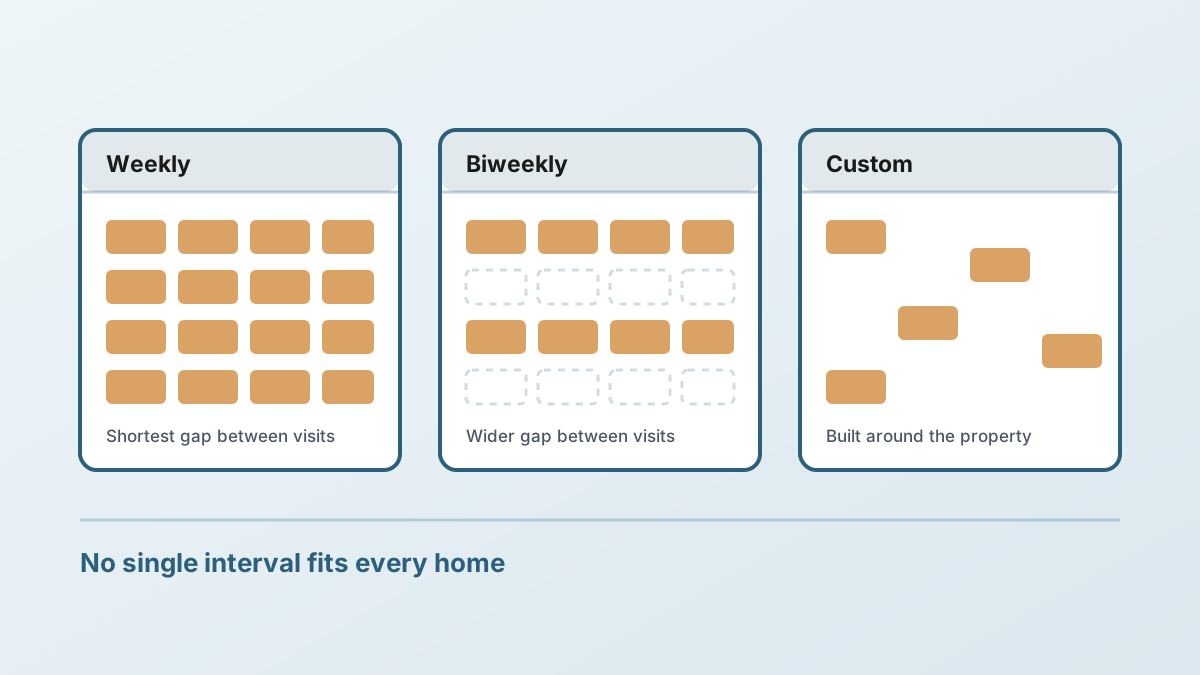
It helps to think about each option in terms of the maximum gap it creates — the longest stretch during which a developing issue could go unobserved. That window, not the label, is what you are actually choosing.
Weekly creates the shortest window. It is the schedule most often chosen for homes that are vacant through a full season, for properties with a known vulnerability, and for periods when work is being done at the house by someone else. It is the most frequent — and therefore the most expensive — cadence, and it produces the densest documentation record.
Biweekly is a middle ground that many owners settle on. It keeps someone walking the property on a regular rhythm at roughly half the visit count of a weekly plan, at the cost of a wider window. For a home that has no history of problems and is otherwise well maintained, this is a reasonable steady-state schedule.
Custom or seasonal is the approach that tends to fit southwest Florida well, because it acknowledges that risk is not constant across the year. A common shape is weekly during the rainy and storm months, and biweekly or monthly during the drier stretch. Owners who use their home part of the year often build the schedule around their own calendar as well — lighter while they are nearby, tighter once they leave.
The point of the custom option is not complexity. It is that a schedule chosen around how a specific property is actually used will usually serve an owner better than one chosen by default, and it costs less than simply running the most frequent cadence year-round.
Want a schedule built around your property?
Tell us how long the home will be empty, what condition it is in, and what you want documented. We will suggest an interval and explain the reasoning behind it.
Request Property ServiceRainy season and storm season change the math
In southwest Florida the summer months concentrate both the rain and the heat, and the Atlantic hurricane season runs from the start of June through the end of November. For a vacant home, both of those windows deserve a shorter interval than the rest of the year.
During the rainy season, the observations that matter most are the ones that only become visible over time: a stain that has spread, a door that no longer closes cleanly, paint that has begun to bubble, a landscape bed that has settled against the house. These are the kinds of visible changes a regular walkthrough is well suited to noticing, precisely because someone is looking at the same features repeatedly and can tell what has changed since the last visit.
Around a storm, the useful practice is to have a documented record on both sides of the event — one from before, one from after. A dated set of observations taken before a storm and another taken afterward gives an owner a clear basis for comparison, which is helpful both for the owner's own understanding and for any later conversation with an insurer, adjuster, or contractor. Scheduling a check before a forecasted event, and another once it is safe to return, is the practical version of that idea.
Worth saying plainly: no check schedule prevents storm damage, and no provider should imply otherwise. A visual check documents what is visible at a point in time. What it can do is reduce the chance that a visible issue goes unnoticed for a long stretch — and after a storm, help establish what was there before.
- Shorten the interval during the rainy season and through hurricane season.
- Take a documented set of observations before a forecasted storm event.
- Schedule a return visit once it is safe, to record the property's condition afterward.
- Keep the records together, so before-and-after comparisons are easy to make later.
- Make sure the provider knows how to reach you if a visit cannot be completed as planned.
What to do during a long absence
A long absence — a full season away, an estate waiting on a sale, a property between occupants — is where the schedule decision carries the most weight. A few habits make the arrangement work better on both sides.
First, put the schedule in writing, including what happens when a visit cannot be completed. Access problems happen, and knowing in advance how they will be handled avoids a gap that nobody notices until later.
Second, decide what you want to receive after each visit. Some owners want a short note only when something notable is found. Others want a report every time. Both are reasonable; the important thing is that the expectation is set before the first visit, not after the third one.
Third, keep the provider informed of changes at the property — a contractor scheduled to work there, a utility shutoff, a landscaper changing days, a neighbor who has been given a key. A check visit is more useful when the person making it knows what is supposed to be happening at the house.
Finally, be realistic about what a visual check covers. It is a set of visible observations made at a point in time. It does not diagnose, and it does not guarantee that every issue will be found. Where a check turns up something requiring licensed or specialized work, the appropriate next step is to coordinate with the appropriate licensed professional where required — not to treat a visual observation as a diagnosis.
If you are preparing to leave a home empty for an extended period, the vacant property checklist for Florida homes covers what to set up before you go, and common problems found in vacant Florida properties describes what regular checks tend to turn up.
Common myths about check frequency
A few ideas circulate about vacant-home checks that are worth correcting, because they lead owners to make decisions based on something that is not accurate.
Does Florida law require weekly checks on an empty home?
There is no blanket state requirement for a specific check frequency on every vacant home. Local ordinances and community rules can apply in specific circumstances, and any such requirement should be verified against the current source rather than assumed. Rather than plan around a general rule, check what applies to your property specifically.
Does a certain frequency satisfy my insurance policy?
Insurance policies vary. Property owners should review their individual policy and ask their insurer or agent about vacancy, unoccupancy, inspection, maintenance, or notification requirements. Insurers do not universally require one specific frequency, and no check schedule should be presented as satisfying a policy's terms.
Can a check prevent mold or water damage?
No. A visual check documents what is visible at a point in time. It may help identify a visible issue so it can be addressed, which can reduce the chance that a small problem continues unnoticed — but it cannot prevent a condition from developing, and it cannot detect something behind a wall or under a cabinet.
Is more frequent always better?
More frequent means a shorter window and denser documentation, which is genuinely valuable in high-risk periods. But a schedule that is more frequent than a property needs is simply more expensive. The goal is an interval matched to the property, not the shortest one available.
Scheduling aside, the broader question is what a check is actually for. How home watch is typically scoped and priced in Sarasota and Bradenton explains how frequency, property type, and documentation combine into a service scope.