
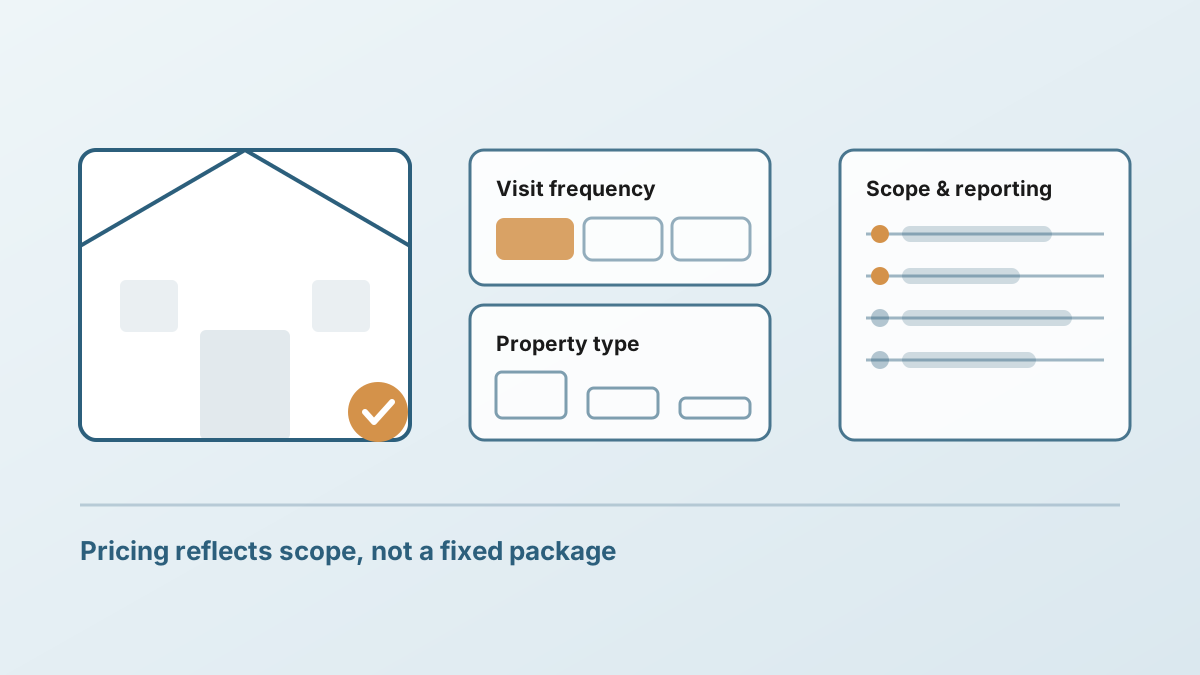
Why there is no single home watch price
Home watch is not a product with a sticker price. It is a service built around a specific property and a specific absence — a snowbird season, a gap between tenants, an estate waiting on a sale, or a home that sits empty while the owner is working elsewhere. Two houses on the same street can carry meaningfully different scopes, and scope is what a provider is actually pricing.
That is why quotes for the same square footage can differ between companies. One may be pricing a quick walkthrough with a text message. Another may be pricing a timed visit with a photo set, a written note on what was observed, and a follow-up call if something needs attention. Both can be described as "home watch," but they are not the same service, and a lower number is not automatically a better one.
The practical takeaway: before comparing prices, get clear on what the visit actually includes. A quote is only meaningful next to the scope it describes.
The factors that actually change the scope
Across the properties Suncoast sees in Sarasota and Manatee County, a handful of variables consistently move the scope up or down. Understanding them makes any quote easier to evaluate.
Visit frequency
The single largest driver. A weekly route and a monthly check are different amounts of labor, mileage, and reporting. Longer gaps also mean a longer list of things to look at on each pass.
Property size and complexity
A single-story home with a straightforward layout takes less time than a multi-level house, a property with outbuildings, a pool, or several separate structures that each need a look.
Travel distance and route
A property inside a regular service route costs less to reach than one that requires a dedicated trip. This is one reason island and outlying properties are often quoted differently.
Documentation depth
A walkthrough with a verbal update is not the same as a timestamped photo set with written observations. More thorough records take more time to produce, but they are also what you can actually reference months later.
Reporting and communication
Some owners want a note only when something is wrong. Others want a report after every visit. Agreeing on this up front keeps expectations aligned on both sides.
Condition and accessibility
A home that is easy to enter and walk has a different visit than one with complicated access, a property under renovation, or areas that cannot be safely reached.
Notice that none of these factors is "how much the owner is willing to spend." Pricing built on scope is stable and explainable. Pricing built on a guess about the owner's budget is neither, which is why a provider who asks real questions before quoting is usually a better sign than one who names a number in the first sentence.
How visit frequency changes the shape of the plan
If you take one thing from a conversation about home watch cost, make it this: frequency is the variable owners most often underestimate, and the one that most changes what a plan is worth.
A weekly schedule means the shortest possible gap between visits, so anything that develops — a slow drip appearing under a sink, a screen that has come loose, a landscape bed that has shifted — is more likely to be observed while it is still small. It also means the most visits per year, and therefore the highest labor and mileage. A biweekly schedule costs less and still keeps someone walking the property regularly, but it accepts a longer window in which a visible issue could go unobserved.
Many owners land somewhere other than either extreme. A common pattern is weekly during the months that matter most — the rainy season, a long absence, or a period when work is being done at the property — and then a lighter cadence in months when the home is occupied part of the time. This is often called a custom or seasonal schedule, and it tends to fit how Sarasota and Bradenton properties are actually used.
There is no single interval that fits every home. What matters is that the schedule is chosen deliberately, in writing, and for a stated reason — not inherited from whatever cadence a provider happens to run by default.
- Agree on how often the property will be visited, and put it in writing.
- Decide whether you want a report after every visit or only when something is notable.
- Confirm what happens if access fails — a lockout, a keypad issue, a vendor who was expected to meet someone.
- Ask how observations are recorded and what the record looks like when you receive it.
- Establish who gets contacted first if something is found, and how quickly you expect to hear about it.
For a closer look at choosing an interval, see how often a vacant Florida home should be checked, which walks through the tradeoffs in more detail.
Not sure what scope your property actually needs?
Tell us about the house, how long it will sit empty, and what you want to know after each visit. We will put together a scope you can compare against any other quote.
Request Property ServiceWhat a documented property check includes
When owners compare home watch pricing, they are often really comparing two different things that share a name. The difference usually comes down to documentation, so it is worth being specific about what a documented check involves.
A documented check is a visit with a record attached. Someone physically walks the property, looks at the interior and exterior, and produces something durable: photos with timestamps, a written note of what was observed, and a clear indication of whether anything warrants attention. That record is the deliverable. It is what lets an owner who is several states away know the state of their property without having to take anyone's word for it.
This matters most in situations where more than one person has a stake in the property. Property managers pass records to owners. Owners pass them to insurers, adjusters, or contractors. Estate representatives keep them for family members. Billing disputes, security-deposit conversations, and post-storm conversations all go more smoothly when there is a dated record of what the property looked like before and after.
It is worth being clear about what this is not. A visual property check is not a licensed home inspection. It is a documented set of visible observations made during a visit — it does not diagnose, certify, or guarantee, and it cannot promise that every issue will be found. A problem hidden behind a wall, inside an attic space, or beneath a cabinet is not visible during a walkthrough, and no visual check can change that. What a check can do is reduce the chance that a visible issue goes unnoticed for a long stretch of time, which is often the difference between a small repair and a large one.
If a visit turns up something that requires licensed or specialized work, the appropriate step is to coordinate with the appropriate licensed professional where required, or to make sure the owner can reach one.
How to compare home watch providers
Once you have two or three quotes in hand, the fastest way to compare them is to compare scopes, not numbers. Quotes that describe different levels of service are not really competing with each other, and choosing on price alone tends to produce a mismatch — either paying for a thoroughness you did not need, or discovering after the first absence that the visits were lighter than you assumed.
Line the quotes up and check whether they agree on visit frequency, what is looked at during a visit, how the visit is recorded, how quickly you are told about a problem, and what happens when the visit cannot be completed as planned. Where a quote is silent on a question, treat that as something to ask rather than something to assume.
It also helps to be clear-eyed about what home watch is not. It is not a security service and does not provide monitoring or response. It is not property management, and it does not involve leasing, tenant placement, or rent collection. It is local, scheduled, documented presence at a property — valuable for exactly what it is, and not a substitute for services that require a license or an emergency line.
Questions to ask before you sign
A short list of questions will tell you more about a home watch provider than any brochure. These are the ones that tend to surface real differences.
What exactly happens during a visit?
You are listening for a walkthrough description, not a promise. A provider who can describe the routine clearly is one whose visits are actually structured.
How will I know the visit happened?
The answer should describe a record — photos, timestamps, a written note. 'We would let you know' is a different commitment than a report after every visit.
What is outside the scope of a check?
Good providers are quick to name limits. A provider who claims to cover everything is describing something no visual check can deliver.
What happens when something is found?
You want a described process: who contacts you, through which channel, and how quickly. Get it in writing while the relationship is calm, not after an incident.
How do you handle access and keys?
Access arrangements matter for both security and reliability. Ask how entry is managed and what happens if a check cannot be completed.
Are there additional charges I should expect?
Ask what falls outside the agreed fee — extra trips, coordinating a vendor, waiting on a contractor — so the invoice does not surprise you.
One more consideration belongs here, and it is not a question for the provider. Many insurance policies treat a home that has been vacant or unoccupied for an extended period differently from one that is lived in, and some place conditions on how the property is looked after during that time. Insurance policies vary. Property owners should review their individual policy and ask their insurer or agent about vacancy, unoccupancy, inspection, maintenance, or notification requirements.
A home watch schedule is not a substitute for understanding your policy, and no provider should suggest that any particular frequency satisfies your insurer's requirements. That is a question for the people who wrote the policy.